Real estate operations · Case study 01
Deploying AI around the work people actually do.
Euphoric Development Partners is the production environment for a connected AI system spanning real leads, clients, tenants, landlords, vendors, transactions, documents, payments, and field work.
- Status
- Live and regularly improved
- Role
- Founder and operator · workflow discovery, product direction, requirements, architecture, testing, deployment, and iteration
- Started
- April 2025
The operating problem
The work was connected. The tools were not.
Property marketing, rental inquiries, tour coordination, paperwork, maintenance, vendor communication, invoicing, and client updates all affected one another—but were often handled through separate inboxes, phone calls, forms, and manual follow-up.
The goal was not to add a generic chatbot. It was to create a practical operating layer that could understand context, move approved work forward, record what happened, and know when a person needed to step in.
That required more than model access. The deployment needed live business data, identity and permission boundaries, tools for taking action, reliable communication channels, evaluation, and clear accountability when an automated workflow reached its limit.
What was built
Specialized roles inside one governed system.
Leasing and realtime voice
Pierce works across email, SMS, phone, and listing sources to handle inquiries, guide prescreening, coordinate self-guided tours, follow up, and route applicants to RentSpree. A realtime voice bridge connects telephone calls to a streaming AI model with interruption and delivery-aware transcript handling.
Document orchestration
Agents can message Brett from the field to begin transaction paperwork. Brett gathers missing information, respects document prerequisites, works through forms and e-signature tools, prepares the packet, and preserves licensed-agent review before consequential action.
Property operations
The platform connects maintenance requests, vendor dispatch, tenant and landlord communication, invoicing, rent collection, payment records, and field observations to the operating data the team already uses.
Tool-connected agent platform
Custom MCP services let authorized assistants work with operational records and external systems instead of relying on pasted context. Specialized agents have distinct roles, instructions, tools, and access boundaries rather than sharing one all-purpose prompt.
Policy and human control
Role policies, per-user access, path-level restrictions, confirmation gates, audit history, and human review define what each workflow may do. Exceptions, legal judgment, and high-consequence actions are escalated with context.
Evaluation and reliability
A Python evaluation harness tests the deployed rental-agent instructions against realistic cases. Quality thresholds and safety gates remain separate, while production failures drive new tests, source-of-truth rules, and workflow changes.
System architecture
The agents work through tools—not invented context.
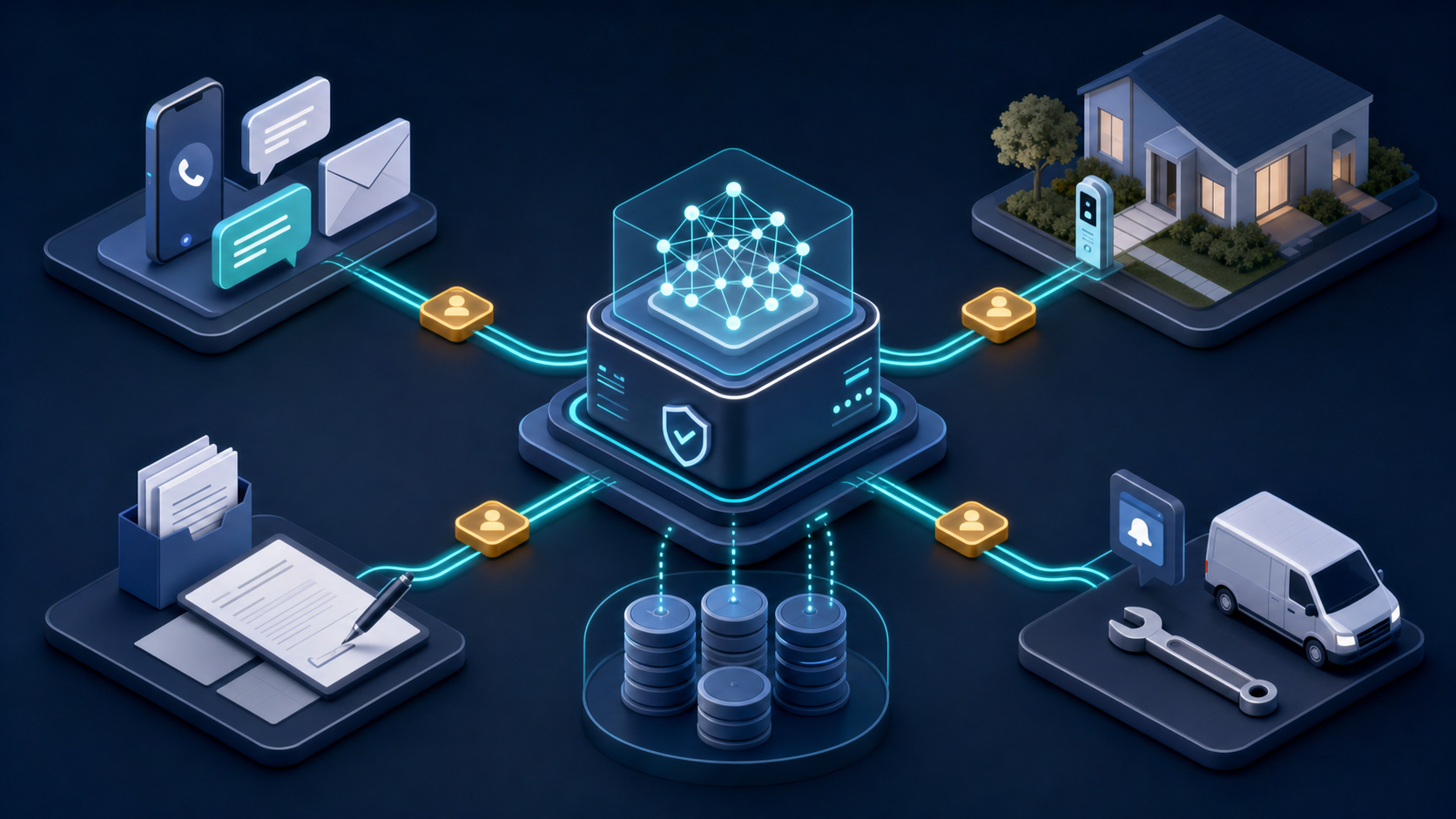
Six interconnected web applications and native mobile clients share an operating data layer. Custom MCP services expose bounded capabilities for property, contact, transaction, document, payment, utility, and third-party property-management workflows.
The agent layer includes Pierce, Brett, and additional specialized roles. Each is designed around a job, a set of allowed tools, and a defined escalation path. OAuth, per-user access, role policies, confirmation boundaries, storage restrictions, and human review help keep useful automation from becoming unrestricted access.
The communication layer spans SMS, email, Telegram, web interfaces, and realtime telephone calls. The system records actions and conversations so that people can inspect what happened and continue the work with the relevant context.
What production taught me
Deployment is the work after the first successful demo.
Start with the workflow
The system grew from observing where agents, prospects, tenants, landlords, and vendors lost time or context. The unit of design was the handoff—not the model demonstration.
Give agents bounded authority
An agent becomes useful when it can take approved action, but dependable deployment requires explicit tools, identity, permissions, confirmations, and escalation paths around that authority.
Test the controls too
The evaluation work found defects in assertions and scorers as well as agent behavior. Safety checks need adversarial tests of their own or a green result can create false confidence.
Operate, observe, revise
Real usage exposed duplicate events, stale records, ambiguous identities, document dependencies, and mismatched sources of truth. Each incident became a product, policy, data, or test improvement.
How it was developed
Operator-led delivery with AI-assisted implementation.
Andrew identified the operational problems, interviewed the work through direct participation, defined requirements and acceptance criteria, directed architecture and integrations, reviewed the resulting code, tested behavior, debugged failures, made release decisions, and remains accountable for the live system.
AI coding assistants produced much of the line-by-line implementation. They were used as engineering collaborators—not as a substitute for understanding the users, deciding what should happen, validating the result, or owning what shipped.
This makes EDP a forward-deployed AI case study: discovery, integration, deployment, adoption, evaluation, and continued improvement happened inside the operating organization rather than in a disconnected prototype.
Apply the principle elsewhere
Your business does not need to look like EDP.
The transferable idea is to begin with a costly workflow, connect automation to authoritative data and carefully bounded tools, measure its behavior, and preserve human judgment where the risk or ambiguity requires it.